

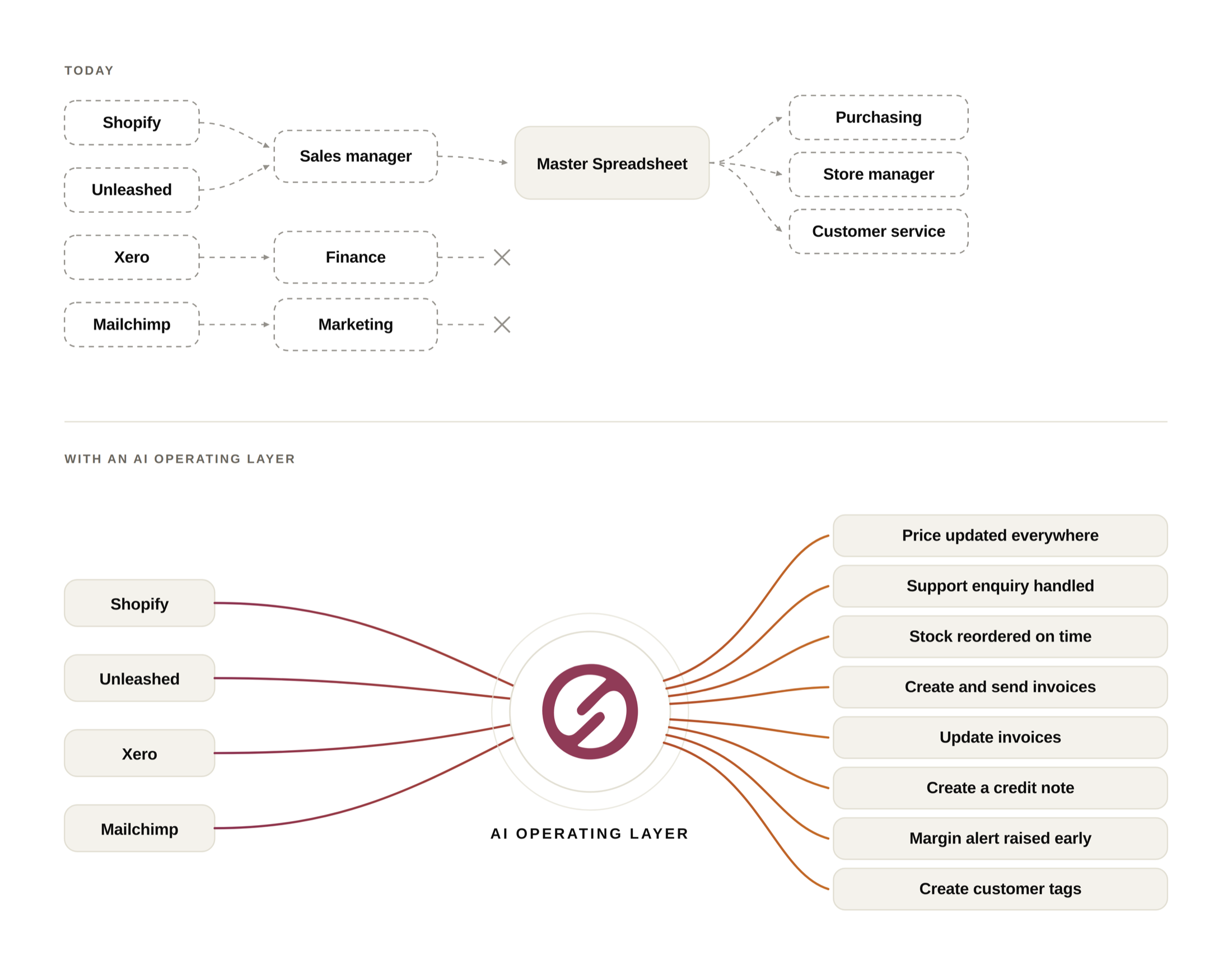
Somewhere in your business, every week, someone rebuilds the same spreadsheet from four system exports.
You probably know who. They do it because the POS, the inventory system, the accounting file and the marketing platform each hold a piece of the truth, and none of them agree on what a customer is. The spreadsheet is the only place the pieces line up. All of that logic lives in one person's head and one person's Downloads folder, and everyone quietly hopes they don't leave.
That is what stops AI working inside real businesses. Not model quality. Not cost. There is simply nowhere the business is written down clearly enough for anything — human or machine — to act on it and be right.
An AI operating layer is that place.
Phase 1
Most companies start by putting an AI licence on every desk and waiting. Some of it sticks. Better emails, faster first drafts, less staring at a blank page. None of it touches operations, because the model has no idea what is happening in your business or how to act.
Ask it about stock cover and it cannot see the stock. Ask it to write to a supplier and it does not know you renegotiated the terms back in March. Ask it to reorder and it has no hands.
Think about AI like an Employee, not a software. Currently it is your worst treated employee. No logins, no training and no context. Yet you expect it to perform out the box.
What MEXE actually does
It gives AI a body. MEXE plugs into the systems your team already live in. ERP, CRM, accounting, ecommerce, POS, marketing and allows any AI to action work inside of the systems you work in. Raise the PO. Update the price. File the ticket. Those are the arms, and they are the difference between AI doing the work and AI describing the work.
It gives AI a brain. Arms without a brain are a liability. The brain comes in two halves.
The first is data. Your systems are siloed, so the same customer, product and order turn up in four places wearing four different names. The layer works out that they are the same thing, so the AI knows the POS customer, the email subscriber and the Xero contact are one person. Every number it gives you can be traced back to the system it came from.
The second is knowledge — everything that explains why the numbers look the way they do. Slack threads, email, the decision you made last spring, policies, SOPs, training guides, brand assets, meeting notes, what the team is working on now, the promo calendar. Anything a good decision rests on gets collected, kept current, and tied to the real things in your data. So when something is actioned, it is backed by years of how your company actually works — not by whatever happened to fit in the prompt.
It gives AI a chain of command. Permissions follow your real org structure, so your CFO sees things your junior accountant does not. That is enforced in the tables underneath, not politely requested in a prompt.
When it has been implemented
AI stops being somewhere people go, and becomes something the business runs on.
The loops close on their own. Stock cover slips below threshold; the layer checks the promo calendar and the supplier lead time, drafts the order at the terms you agreed, and puts it in front of a person to approve. A margin moves the wrong way and somebody hears about it before month-end, not after. A call comes in at 9pm and whoever picks it up can see the real order, the real policy and the real history.
Nobody rebuilds the Monday spreadsheet. It builds itself, and it is right.
None of this is really about headcount. It is that the people you pay for their judgement stop losing half their week to assembling context, and get it back for the decisions that need a person in the room — the supplier meeting, the store visit, the call that saves the account.
In summary
You already have the data, the knowledge and the systems. They are just spread across fourteen places, and none of them talk to each other.
An AI operating layer is what joins them up. It is the difference between a company that uses AI and a company that runs on it.